Broad shoulders have long been celebrated on high-fashion runways and athletic fields alike. They lend natural poise to tailored garments, provide an innate hanger appeal, and give the body an enviable, statuesque presence. Yet, outside the structured world of editorial shoots, dressing a broad-shouldered frame can occasionally feel like an exercise in spatial negotiation.
Standard off-the-rack garments often seem designed with narrower proportions in mind. Button-down shirts pull taut across the upper back, structured blazers risk looking boxy rather than sharp, and high-necked tops can inadvertently make the torso appear top-heavy.
Dressing broad shoulders well is never about trying to conceal your frame or apologizing for an athletic build. It is an exercise in visual architecture. By understanding how lines, seam placements, fabric weights, and lower-body proportions interact, you can effortlessly balance your silhouette, direct the eye where you want it to go, and highlight your natural structure with confidence.
The Geometry of Necklines: Breaking the Horizontal Plane
The neckline is the single most influential element in determining how broad your shoulders appear. A neckline acts as a frame for the clavicle and neck, setting the primary visual vector for the entire upper body.
When shoulders are broad, the natural line across the collarbone is strong and uninterrupted. If you place a wide, horizontal neckline directly on top of that frame, you reinforce that width. Conversely, introducing vertical or diagonal breaks immediately softens the horizontal plane.
The Power of the Deep V-Neck
The classic V-neck is the most effective neckline for balancing wide shoulders. By cutting downward toward the sternum, a V-neck introduces an aggressive vertical axis. This triangular shape draws the viewer’s eye inward and downward, splitting the chest into two narrower visual zones.
This does not mean you are restricted to plunging necklines. Even a modest, narrow V-neck on an everyday sweater or t-shirt works wonders. The key is the sharp angle: it disrupts the horizontal line running from shoulder tip to shoulder tip, instantly elongating both the neck and the torso.
Scoops, Cowls, and Sweethearts
If angular necklines do not suit your personal aesthetic, rounded silhouettes that drop low offer the same vertical advantage with a softer finish.
A generous scoop neck opens up the décolletage, creating breathing room between the chin and the chest. Cowl necks introduce soft, undulating folds of fabric that drape downward in a gentle U-shape, adding movement that blurs rigid shoulder lines. Sweetheart necklines, with their curved, heart-shaped cut, naturally draw attention toward the center of the bust and provide an elegant counterweight to broad bone structure.
Asymmetry and Diagonal Cuts
One-shoulder tops, asymmetrical necklines, and diagonal wrap cuts are exceptional choices for broad builds. A diagonal line across the chest visually cuts through the widest point of the torso. Instead of reading the shoulders as a single, unbroken horizontal bar, the eye follows the slant of the fabric. This creates an artistic, dynamic silhouette that celebrates shoulder shape without exaggerating its span.
Necklines to Approach with Caution
Styles that draw a rigid, flat line across the clavicle tend to emphasize shoulder width. Boatnecks (bateau), wide square necks, and off-the-shoulder Bardot cuts act like horizontal arrows pointing directly outward. Similarly, high, restrictive crewnecks paired with tight fabric can create an expansive, uninterrupted block of fabric across the chest, making the upper frame feel wider than it actually is.
Sleeve Dynamics and Seam Construction
Where a sleeve connects to a garment determines how the shoulder line is framed. The seam that circles the armhole—known in tailoring as the armscye—dictates the visual perimeter of your upper body.
Raglan and Dolman Sleeves
Standard set-in sleeves feature a vertical seam that sits right at the edge of the shoulder bone. If this seam sits even half an inch too far outward, it adds instant bulk.
Raglan sleeves completely eliminate the traditional shoulder seam. Instead, the sleeve extends in one continuous piece all the way to the collar, connected by a diagonal seam running from the underarm to the neckline. This diagonal construction softens the shoulder joint, creating a smooth, sloped line that naturally minimizes breadth. Dolman and batwing sleeves operate on a similar principle, cutting the body and sleeve from a continuous piece of fabric to bypass rigid shoulder points entirely.
Managing Drop Shoulders
Drop-shoulder tops and sweaters are everywhere in modern casualwear. They can either work beautifully or backfire depending on the fabric weight:
-
In stiff, heavy fabrics, a drop shoulder seam can jut out horizontally, creating an awkward boxy ridge outside your actual shoulder.
-
In lightweight, fluid knits, the seam falls naturally down the upper arm, collapsing softly against your body and producing a relaxed, effortless drape.
When shopping for drop-shoulder silhouettes, always look for fabrics with minimal structure that yield to gravity rather than holding their own shape.
The Sleeveless Equation: Wide Straps Over Spaghetti Straps
When wearing tank tops, sundresses, or sleeveless tops, strap width matters significantly.
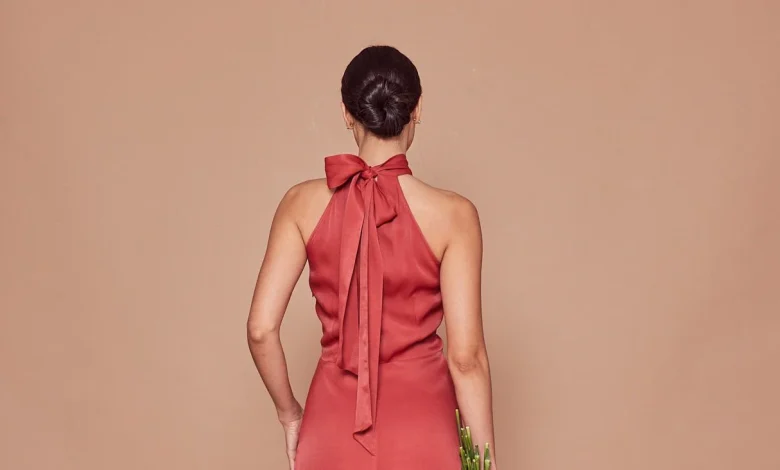
Very thin spaghetti straps create a stark visual contrast against a broad shoulder, making the area of exposed skin look wider by comparison. Wider shoulder straps measuring at least two to three inches cover a broader portion of the shoulder girdle, effectively sectioning off the width and creating a balanced, harmonious look. Halter necks with substantial bands that angle inward toward the neck are also remarkably flattering, as they pull the visual focus toward the center of the body.
Fabric Weight: Prioritizing Fluid Drape Over Stiff Volume
The architectural integrity of a silhouette depends entirely on the textile used to build it. Two shirts with identical measurements will look completely different if one is tailored from stiff cotton poplin and the other is cut from washed silk.
Broad shoulders already provide an internal architectural hanger. Because your bone structure naturally supports garments, you do not need stiff, heavy fabrics to build an interesting shape for you.
Choose fabrics with high fluid drape that cascade over your curves and angles:
-
Silk, rayon, and high-quality viscose
-
Fine-gauge merino wool and cashmere knits
-
Washed linen-cotton blends with natural give
-
Modal and heavyweight bamboo jersey
Avoid rigid, boxy fabrics that stand away from the body, such as heavy brocades, stiff bonded neoprenes, or paper-crisp cottons with exaggerated structure in the chest. These textiles treat broad shoulders like an anchor point and flare outward, creating a blocky silhouette that obscures the waist and adds bulk to the torso.
Establishing Equilibrium: Building Lower-Body Volume
Styling broad shoulders is only half about what you wear on top; the other half is what you wear on the bottom. An inverted triangle silhouette—where the shoulders are substantially wider than the hips—often looks unbalanced when paired with ultra-tapered or skinny pants, which narrow the lower half and emphasize upper breadth.
To create an effortless hourglass harmony, use the lower body to mirror the width of your shoulders.
Wide-Leg Trousers and Palazzos
Wide-leg trousers are arguably the most transformative garment for a broad-shouldered frame. High-waisted, wide-leg trousers fall straight or flare gently from the hip to the floor, adding visual weight that grounds your lower half.
When the hem of your pants matches or slightly exceeds the width of your shoulders, your silhouette immediately reads as balanced and proportional. Pair fluid palazzo pants or tailored menswear-style pleated trousers with a slim-fitting V-neck tucked into the waistband for an instant lengthening effect.
A-Line and Pleated Skirts
Skirts that taper inward toward the knees, like traditional tight pencil skirts, exaggerate upper-body width. Instead, lean into A-line cuts, pleated midi skirts, and circle skirts.
An A-line silhouette skims past the hips and widens gradually toward the hem. This creates a balanced geometric mirror to your shoulders, naturally defining the waistline without any need for aggressive tailoring. Bias-cut satin skirts that flare gently at the calf achieve a similar balance with a softer, more fluid movement.
Flared and Bootcut Denim
If wide-leg trousers feel too voluminous for everyday wear, bootcut and flared jeans are the ideal compromise. By flaring out slightly from the knee down, bootcut jeans restore visual weight to the lower legs, preventing the top-heavy look that often occurs when broad shoulders are paired with tight ankle jeans.
Tailoring Outerwear: Blazers, Coats, and Jackets
Outerwear is often the trickiest category for broad builds because jackets are traditionally constructed with built-in structure. A few thoughtful tailoring checks ensure your outerwear looks sharp rather than restrictive.
The Unstructured Blazer
For years, corporate tailoring relied on thick foam shoulder pads to create authority. On a broad-shouldered frame, built-in padding simply adds redundant bulk.
Look for unstructured or soft-tailored blazers crafted without shoulder padding, or with minimal, wafer-thin inserts designed only to hold the seam flat. Italian-style tailoring (often featuring a soft spalla camicia or shirt-style shoulder) molds to your natural body line rather than imposing a synthetic box shape over it.
Deep, Elongated Lapels
Pay close attention to the lapels on coats and blazers:
-
Avoid high, wide, horizontal notch lapels that draw the eye toward the shoulder seams.
-
Choose long, narrow lapels with a low gorge line (the seam where the collar meets the lapel). A low single-button closure creates a long, sweeping V-shape that pulls the eye downward through the torso.
-
Shawl collars, which curve in an unbroken, rounded line from neck to waist, soften upper-body angles beautifully.
Belted Trenches and Duster Coats
Longline coats that fall past the knee create a continuous, unbroken vertical line that lengthens the entire body. Classic trench coats with tie belts allow you to cinch the waist, creating a defined hourglass shape that offsets broad shoulders. If a trench features bulky, military-style epaulets on the shoulders, look for a style where they lay completely flat, or have a tailor remove them for a cleaner, sleeker shoulder plane.
Embodying Your Natural Architecture
Personal style is ultimately an exercise in harmony, not correction. Broad shoulders lend an innate dignity, strength, and presence to almost every outfit when they are allowed to anchor a look naturally.
By choosing open, vertical necklines, embracing fluid fabrics that skim rather than flare, and anchoring your lower half with wide-leg pants and A-line hems, you create an effortless visual balance. When your clothes work with your natural lines instead of fighting them, getting dressed becomes intuitive, and your frame becomes your greatest stylistic asset.